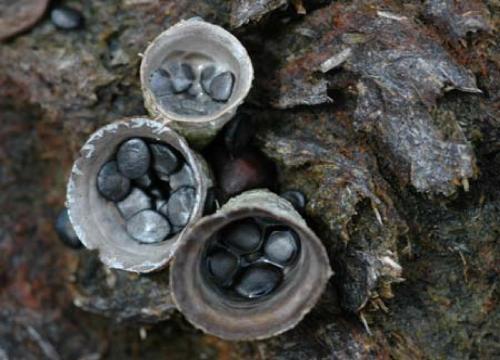
Nidula sp.
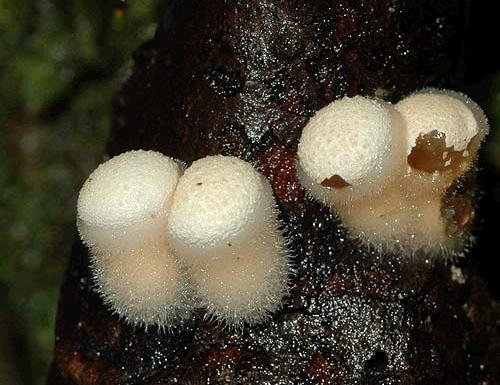
This species was known as Nidula niveotomentosa but genetic studies have shown that this is not the same as the Northern Hemispere species. It will be renamed at some stage.
This species has a woolly covering on the outside of the cup, hence its common name “woolly bird’s nest”. The peridioles (“eggs”) are pale brown. Diam: 5–7 mm.
They are very small cup-like structures which look like a tiny bird's nest covered by a thin skin or lid. When this lid peels back, you can see things that look like eggs, but they are actually little bundles (peridioles) of compressed spores. These are covered with a sticky substance so that when they are splashed out by rain drops, they stick to the the suface they land on.
The furry (woolly) covering of these fungi makes it easily distinguishable.
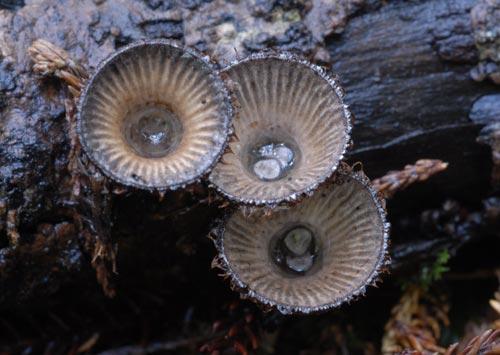
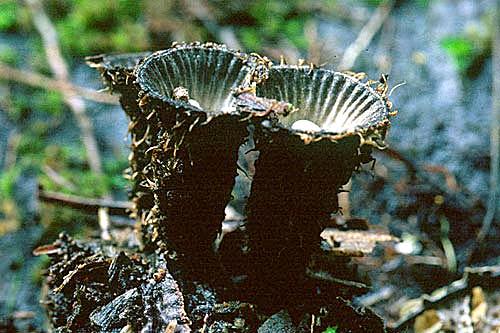
Cyathus novae-zeelandiae Tul. & C. Tul.
These are taller than the other two species, and the outside has a brown hairy appearance, while the inside of the cup is striped vertically.
The peridioles of the Cyathus are similar to those of Crucibulum laeve in that they also are attached by threads.
Cyathus stercoreus (Schwein.) De Toni
Usually found on animal manure in pasture. The outside of the nest is shaggy, the inside is grey with pale concentric lines and the peridioles are dark grey. Diam: 5–7 mm.
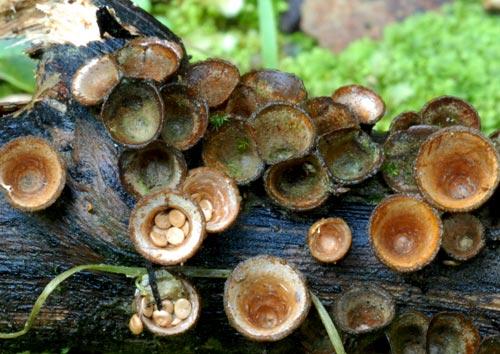
Crucibulum laeve (Huds.) Kambly
The outside of the fungus is felty and a pale cream-brown colour. The cups are 4–7 mm in diameter. The peridioles are a cream colour. They contain the spores.
Usually found on twigs in the bush. When raindrops land in the cup the "eggs" (peridioles) are flung out with the splashes and they attach themselves to anything they can with a whip-like tail that had been holding the egg in the cup.
Birds Nest Fungi
These are very specialised for the dispersal of their spores.