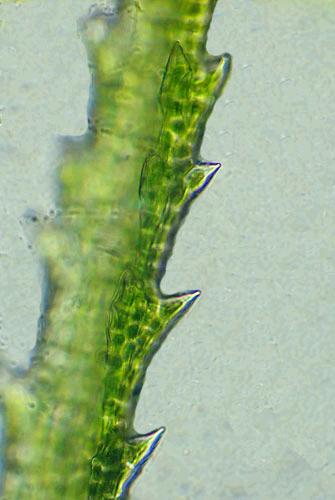
Cryptopodium bartramioides
Growing on trunks of trees and tree ferns.
The brownish colour of the old shoots helps to distinguish this moss.
Pyrrhobryum bifarium
Found growing on rotting wood.
The plants of this species are like tiny trees.
In the third photo you can see the double teeth of the leaf margin.
Hymenodon pilifer
These are found on the trunks of trees, tree ferns and nikau palms, and sometimes on soil under overhangs.
The leaf is quite distinctive with its long hair-point.
This image shows the double teeth of the leaf margin.
Pyrrhobryum mnioides
This species is found on soil.
The stems are unbranched, and it also has double teeth on the leaf margin.
Rhizogonium distichum
Found on rotting wood in the forest.
It doesn't have double teeth on the leaf margin.
The stems are unbranched and the leaves are in two rows.
I find it quite a distinctive and easy-to-recognise moss.
This image shows the sporophytes of P. bifarium
A close-up of the leaf arrangement of Calomnion complanatum
A capsule of Rhizogonium distichum.
Calomnion complanatum
Found on certain species of tree ferns.
The leaves are in three rows, with the smaller leaves being circular and on top of the stem.
The capsules of Goniobryum subbasilare
The leaf margin has conspicuous double teeth.
Goniobryum subbasilare
Grows on bark, earth or rock.
The leaf margin has conspicuous double teeth as seen in the image below.
The teeth on the margins of the leaves are double.
This feature can be used to separate this species from its look-alikes, Cyrtopus setosus which has single teeth and Echinodium hispidum which has no teeth on the leaf margin.


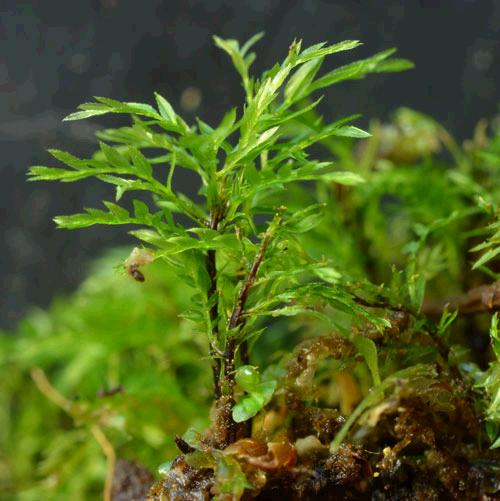
Rhizogoniaceae
In this family the leaf margin is often toothed and thickened.