Rebouliaceae
Some botanists use the name Aytoniaceae for this family.
Asterella australis
Found on damp partially shaded banks.
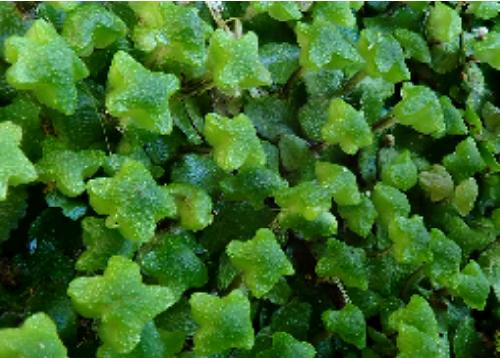
It could be mistaken for a Marchantia, but the thallus is more ribbon-like.
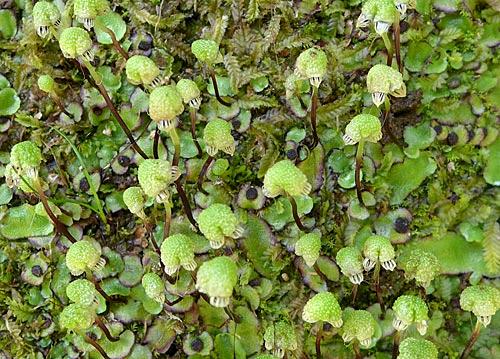
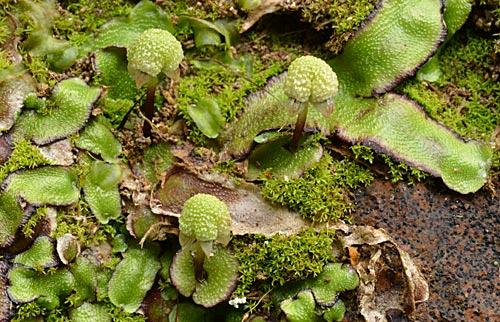
The tall structures are fruiting bodies called carpophores or carpocephala.
The dark purplish patches at the tips of the thallus are the androecia - the males parts.
Showing the archegoniophores at a more developed stage.
The other dark spots at the tip of the thallus are the antheridiophores where the sperm are produced.
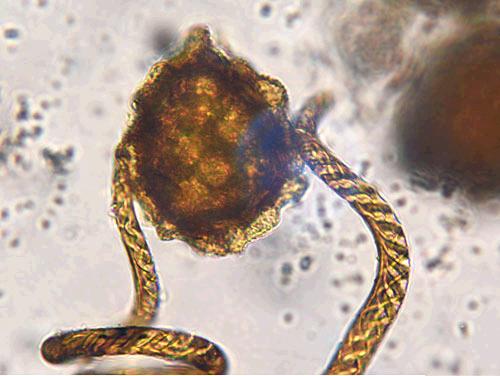
This image shows one of many thousands of spores from the sporophyte. It has a reticulated (patterned) surface. The long structure with spirals is an elater, the shape of which changes on variations in humidity and aids in the discharge and dispersal of the spores.
Reboulia hemisphaerica
The small cross-shaped structures are immature archegoniophores containing an egg which, after fertilisation, will develop into a sporophyte containing spores.
The little white dots on the thallus and archegoniophores are pores which open into chambers, facilitating gas exchange.
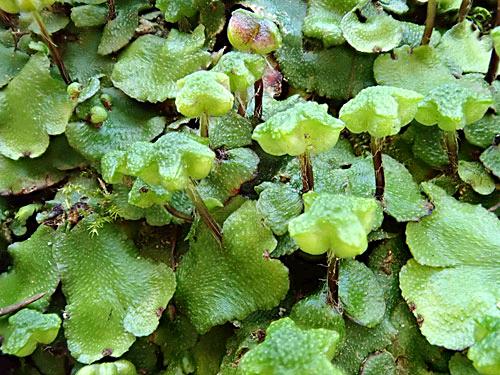
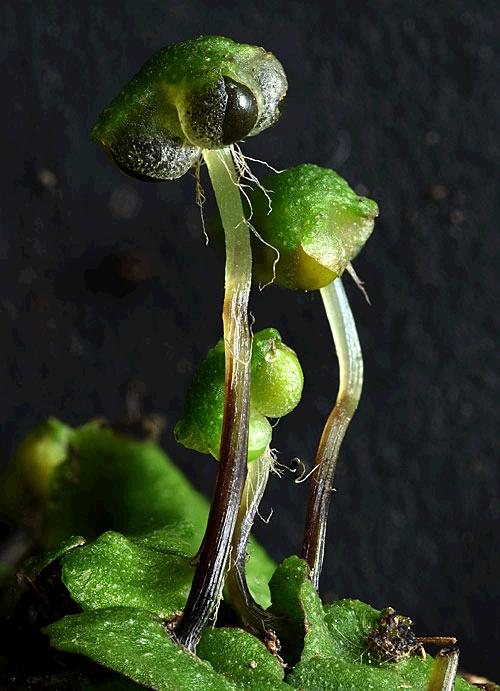
This image shows three archegoniophores at different stages of development. The sporophyte is the round structure which becomes black on maturity.
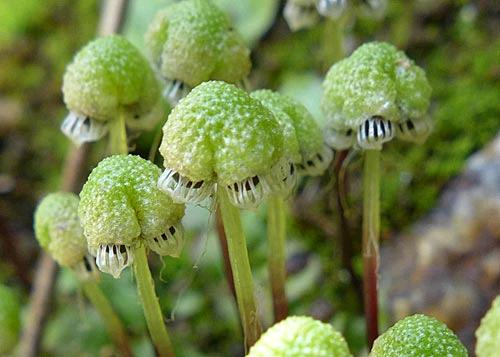
The white lacey structures coming from underneath the carpophores are the perianths and the black structure inside those are the capsules of the sporophytes.